Building Reliable AI Workflows with Agentic Search

Building Reliable AI Workflows with Agentic Search
Modern enterprises are moving beyond conversational AI as the primary way to measure AI effectiveness. Instead, the focus is shifting toward Agentic AI systems that can plan, use tools, and drive multi-step workflows to completion. This approach delivers measurable outcomes across real business workflows, not just helpful text.
While Agentic AI systems unlock powerful capabilities, they do not scale on reasoning alone. Every agent must operate within a clear workflow and rely on accurate, trusted information to make correct decisions.
An agent that plans and acts without reliable context:
- Produces unstable results
- Hallucinates or makes unsafe assumptions
- Cannot be trusted in enterprise production environments
To make Agentic AI systems reliable, we need a structured way to provide high-quality context to agents at every step.
This is where Agentic search becomes essential.
Agentic search enables agents to consistently retrieve the right, trusted context from enterprise sources and ground their decisions on that context.
Understanding AI Agents
An AI agent is a goal-driven software system that operates autonomously. It decides what to do next, uses available tools, and performs tasks rather than simply producing text.
Agents serve as the fundamental building blocks and essential components that form the foundation of Agentic AI systems.
Agentic search is a specialized agent within an Agentic AI system. Its responsibility is to support other agents by providing accurate and relevant information.
Agentic search enables:
- Ground decisions in enterprise data by querying trusted sources and validating information before use
- Reduce hallucinations through iterative verification, cross-referencing multiple sources, and evaluating result quality at each step
- Deliver production-ready outputs by ensuring consistency, reliability, and alignment with business requirements through structured workflows
In this blog, we share our experience tackling these challenges to deliver enterprise-grade Agentic products that are reliable, scalable, and production-ready.
RAG vs Agentic Search
-
Retrieval Augmented Generation (RAG) is a technique for enhancing the Large Language Model (LLM) answering by feeding the model the knowledge it needs based on the user's query.
limitations: it becomes a limitation when the question requires deeper reasoning, multi-step exploration, cross-referencing multiple sources, handling ambiguous queries, or synthesizing information from various documents to form a comprehensive answer.
-
Agentic Search on the other hand, is more capable because it behaves like an AI assistant with a goal, not just a “retrieve and answer” system. Instead of doing one retrieval and answer, an agent can: Plan → Search → Evaluate → Improve → Search again → Final Answer
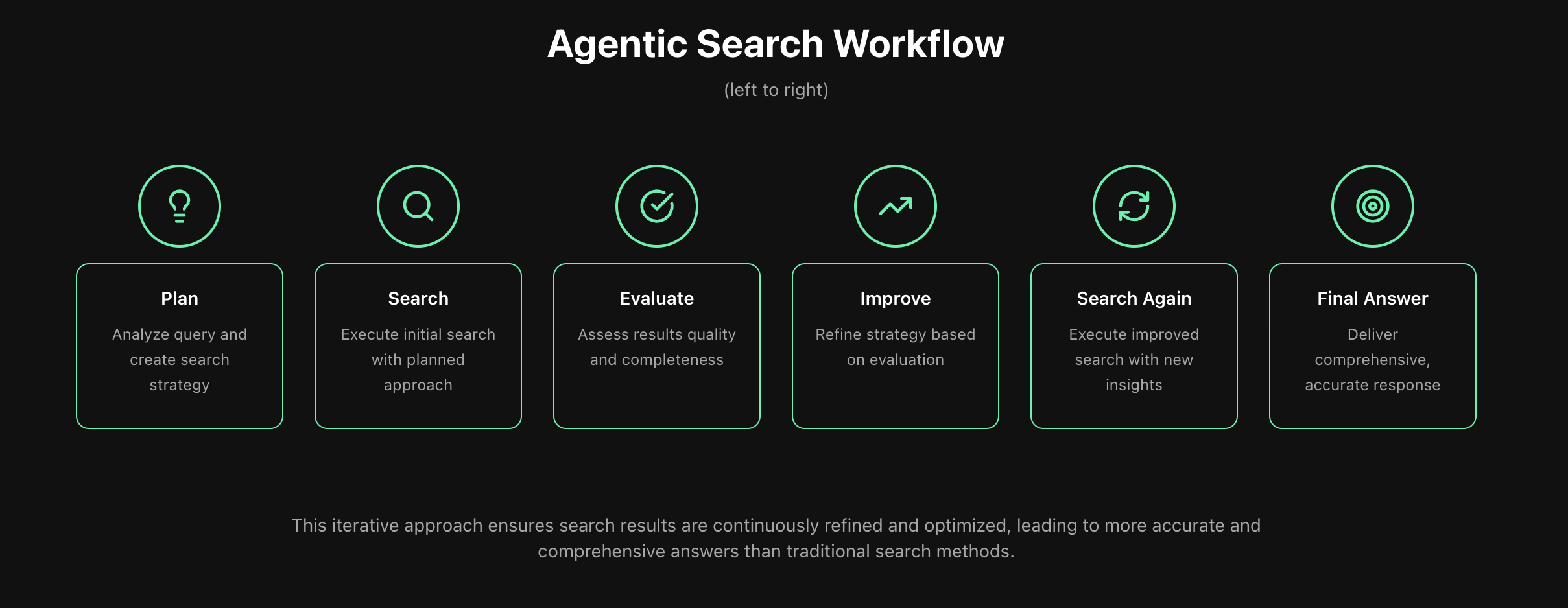
Agentic search adds the missing part: thinking + actions, not only retrieval. which solves typical RAG problems.
Why do we need Agentic Search?
-
Tools and Actions Variety
Uses different tools based on the task (Knowledge bases, Web search, Databases, etc..)
-
Sequential Explorations and Ambiguity Handling
User questions aren't always clear, thus it requires multiple steps. Agentic search works in cycles: search → evaluate → refine → search again until finding a complete answer.
How to set up an Agentic Search system?
Building an Agentic search system is not only about adding “search” to an LLM.
You need to design the workflow, actions, iterations.
- Prompt Engineering
- Define the agent role clearly to give the agent a stable identity and behavior.
- Define the tools usage (Explain what tools exist, when to use each tool in brief)
- Add quality rules for example “retry search if results are weak”.
- Tools Selection
- Pick the core search tools (Knowledge bases, Web search, Databases, etc..)
- Make tools easy to use (clear naming, clear inputs/outputs, detailed description) for the model to know what tool to choose.
Problems of Agentic Search
Agentic search is powerful, but it comes with higher cost and slower performance. multiple steps like (Plan → Search → Evaluate → Improve → Search again → Final Answer) consumes more GPU resources, takes a loot of time.
On the other hand unlike RAG systems which considered faster and cheaper due to “retrieve and answer” approach.
Agentic search trades that efficiency for better handling of complex tasks, but the trade-off is speed and resource usage.
Summary
Traditional RAG systems fall short when queries require multi-step reasoning, cross-referencing, or handling ambiguity. Agentic search addresses these gaps by planning, evaluating, and refining searches until it delivers accurate, enterprise-grade answers grounded in trusted data.
As enterprises scale AI adoption, the challenge will shift from "Can AI answer questions?" to "Can AI autonomously drive complex workflows reliably?"
The future of Agentic search lies in overcoming these limitations. It will evolve to become faster, more cost-efficient, and deeply integrated into business processes, forming the foundation for truly autonomous enterprise systems that not only retrieve information but orchestrate intelligent action across organizations.
At Entropy, We’re tackling these challenges for enterprises helping teams move from promising ideas to systems that are secure, reliable, and ready to scale. If you’re aiming to transform your enterprise into autonomous one, Reach Out!